Enterprise SaaS · IFRS 9 · Expected Credit Loss

IFRS 9 ECL Suite
Enterprise V1.0

An institutional-grade Expected Credit Loss modelling platform — PD calibration, LGD analysis, forward-looking macroeconomic overlays, and full audit-trail provisioning in a single enterprise SaaS.

IFRS 9 ECL Results Dashboard — Stage-level ECL breakdown
PD Migration Analysis· LGD Modelling· EAD Calculation· Stage 1 / 2 / 3 Classification· 12-Month ECL· Lifetime ECL· Macroeconomic Overlays· Forward-Looking PD· Scenario Weighting· Immutable Audit Trail· REST API Integration· Model Validation· IFRS 7 Disclosures· PD Migration Analysis· LGD Modelling· EAD Calculation· Stage 1 / 2 / 3 Classification· Macroeconomic Overlays·
PD · LGD · EAD
Three-Component Model
12M & Lifetime
ECL Horizons
Stage 1 / 2 / 3
Auto Classification
Base · Opt · Pess
Macro Scenarios
REST API
Core Banking Integration
Full Log
Immutable Audit Trail
01
PD Engine

Statistical PD Modelling with Forward-Looking Adjustments

The PD Engine constructs Probability of Default curves from historical migration data, applies logistic regression calibration, and projects Point-In-Time PDs under multiple macroeconomic scenarios using validated MEV relationships.

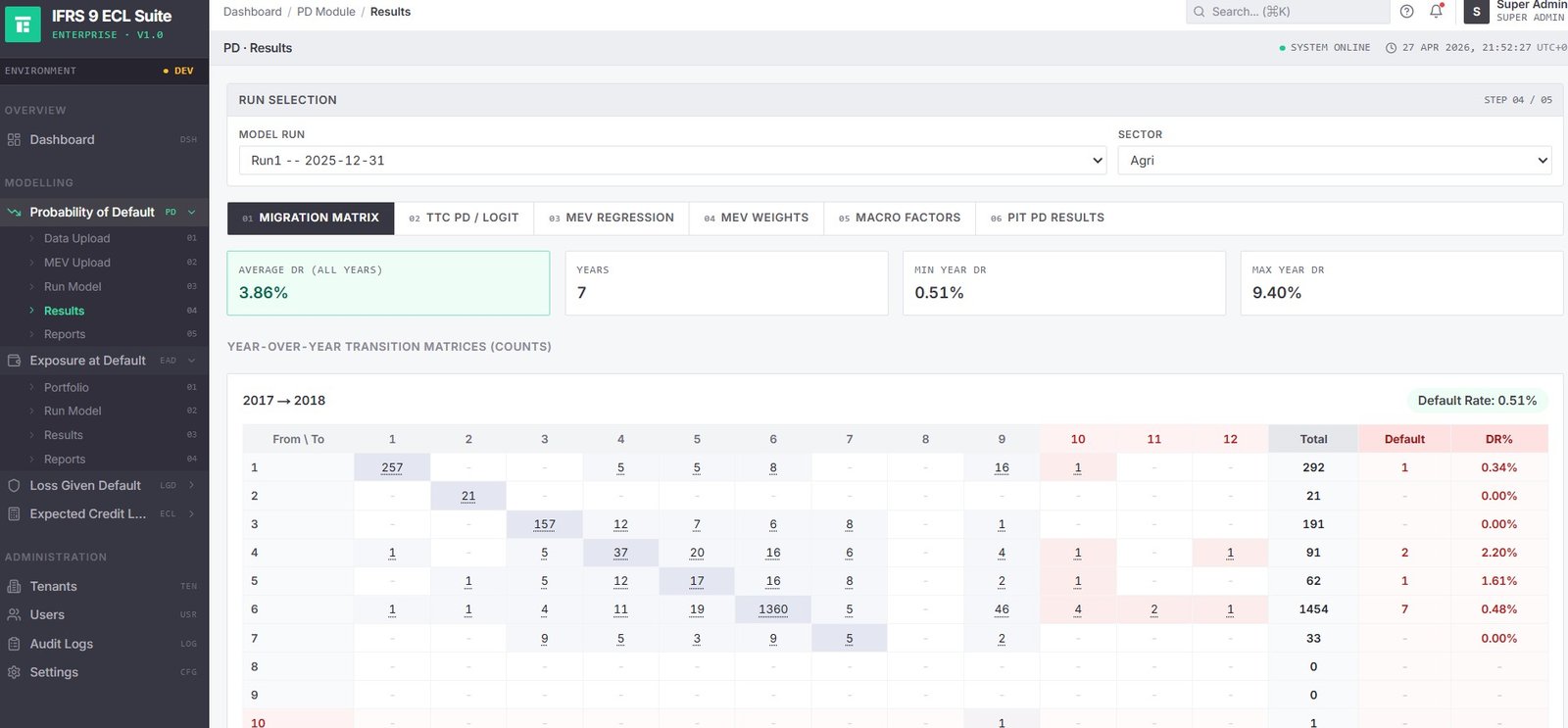
  • Year-over-year PD migration matrix across up to 7 historical years
  • Logit/OLS regression calibration with goodness-of-fit statistics
  • Exhaustive C(n,k) macroeconomic variable search with ANOVA F-test filtering
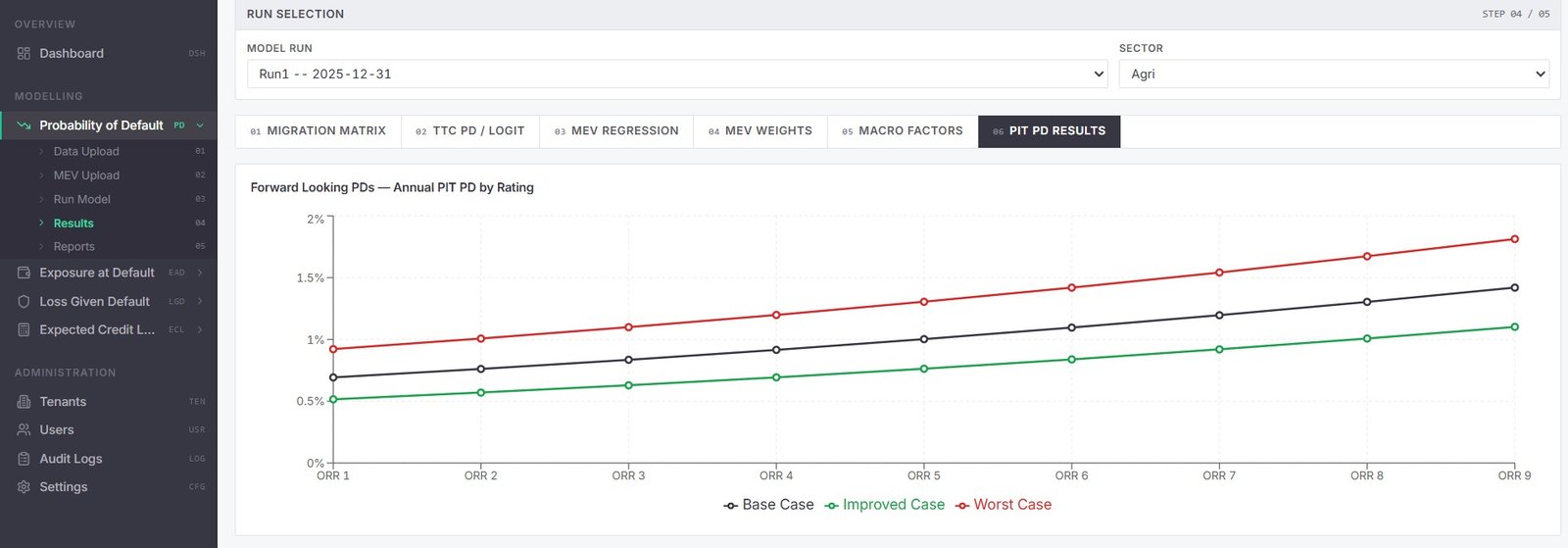
  • PIT PD projections: Base, Improved, and Worst Case scenarios
  • Through-the-cycle to point-in-time PD conversion with scenario overlay
  • Model validation outputs for regulatory and audit review
PIT PD Forward-Looking Curves — Base, Improved, Worst Case
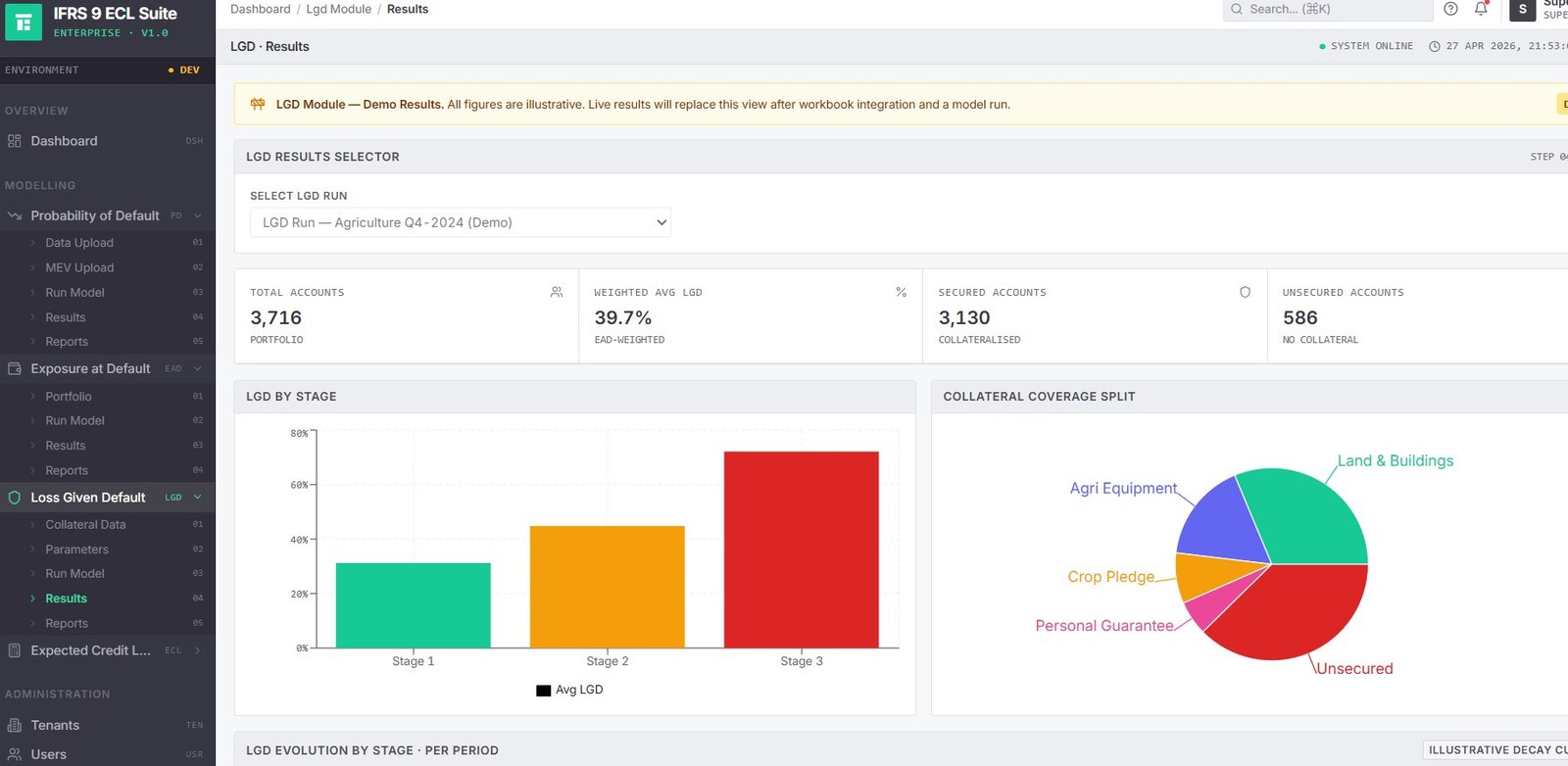
LGD Analysis — Portfolio-level Loss Given Default breakdown
02
LGD Module

Portfolio-Level Loss Given Default Analysis

Compute and validate Loss Given Default across your full loan portfolio. The LGD module segments by secured vs. unsecured exposure, analyses collateral coverage, and produces stage-stratified LGD outputs ready for the ECL calculation engine.

  • Portfolio-wide weighted average LGD computed across all accounts
  • Secured vs. unsecured account segmentation with separate LGD treatment
  • LGD by Stage (Stage 1 / 2 / 3) with visual comparison
  • Collateral coverage split analysis with breakdown chart
  • LGD validation against industry benchmarks
  • Structured export direct to ECL calculation module
03
ECL Calculation

Scenario-Weighted ECL with Stage-Level Precision

Combine calibrated PD, LGD, and EAD inputs to compute Expected Credit Loss across Stage 1, 2, and 3 — with probability-weighted macroeconomic scenario overlays, management adjustment capability, and period-to-period movement reconciliation.

  • Total ECL computed and disaggregated across the full portfolio
  • Stage-level ECL split: Stage 1 (12-month), Stage 2 & 3 (lifetime)
  • Configurable scenario probability weights — Base, Optimistic, Pessimistic
  • Coverage ratio monitoring with period-to-period movement reconciliation
  • Provision waterfall from prior period with stage transfer tracking
  • One-click export: journals, disclosures, movement tables
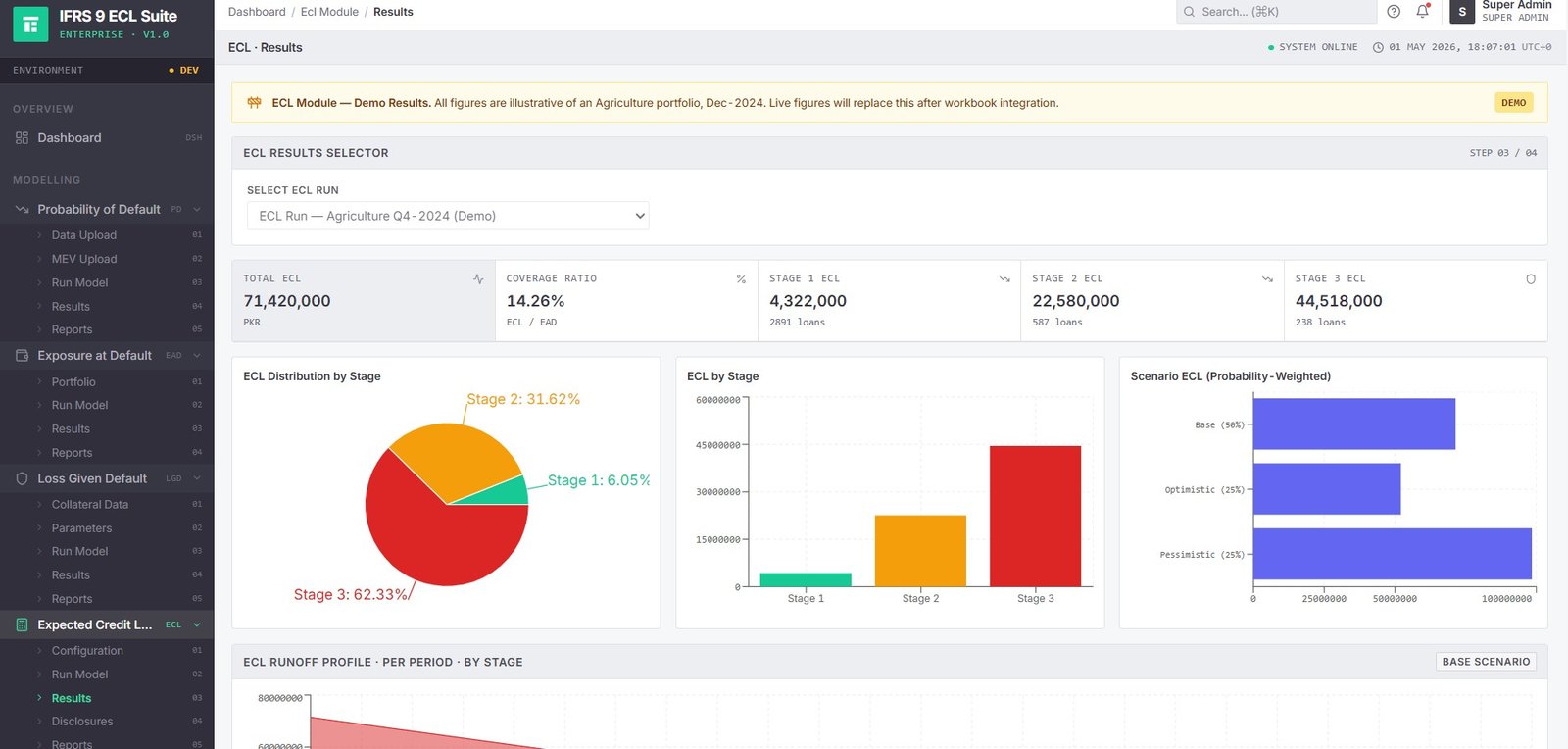
ECL Results — Stage 1/2/3 breakdown, coverage ratio

Rigorous Statistical Framework

Built on peer-reviewed quantitative methodology — not black-box calculations. Every model output is fully traceable, explainable, and audit-ready.

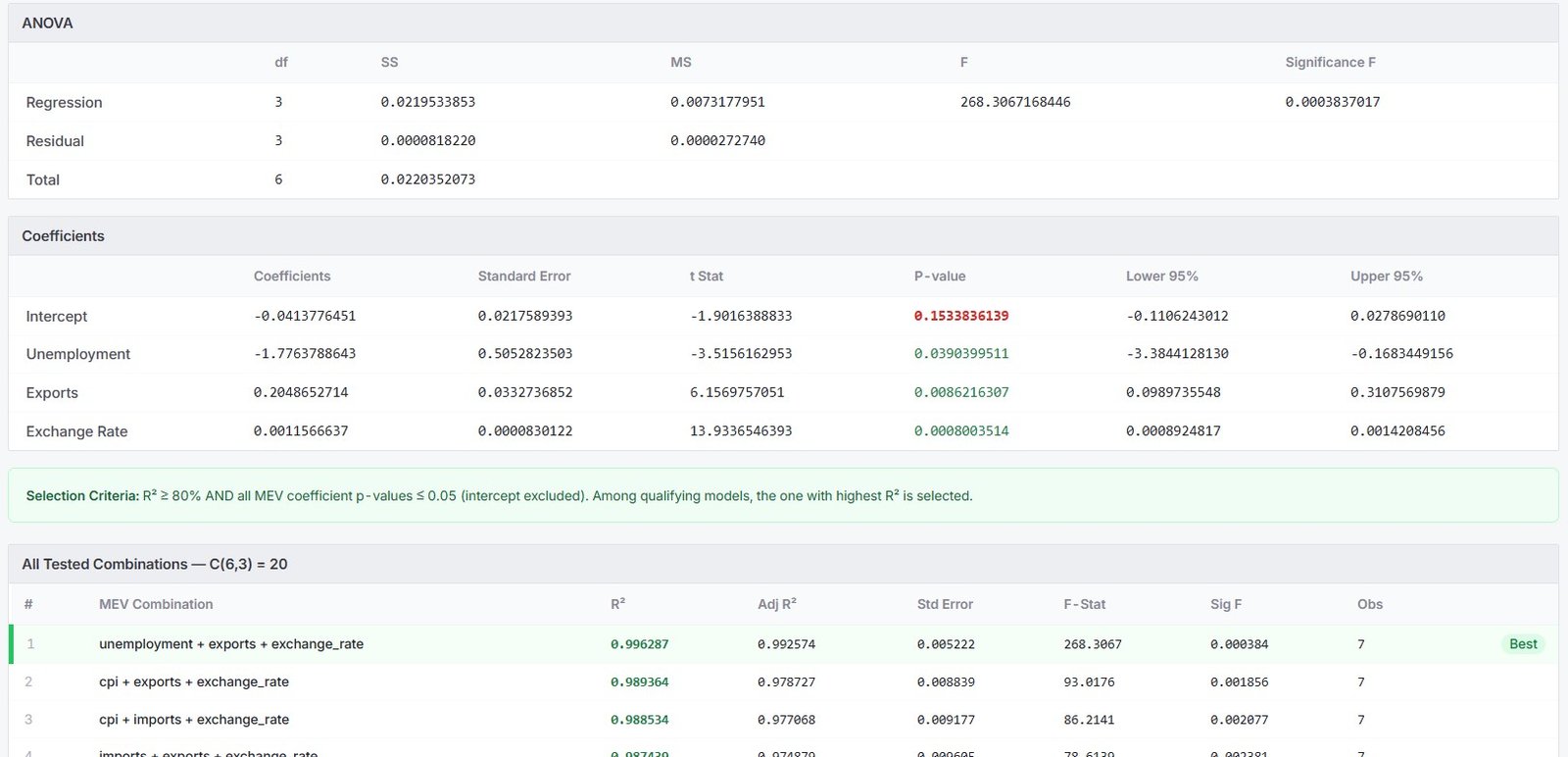
Macroeconomic Variable Regression — MEV selection and ANOVA output
MEV Regression

Macroeconomic Variable Selection

Exhaustive C(n,k) variable combination search with ANOVA F-test filtering. Identifies the optimal macroeconomic variables — typically GDP, Unemployment, Exchange Rate, or sector-specific drivers — with full regression output for audit review.

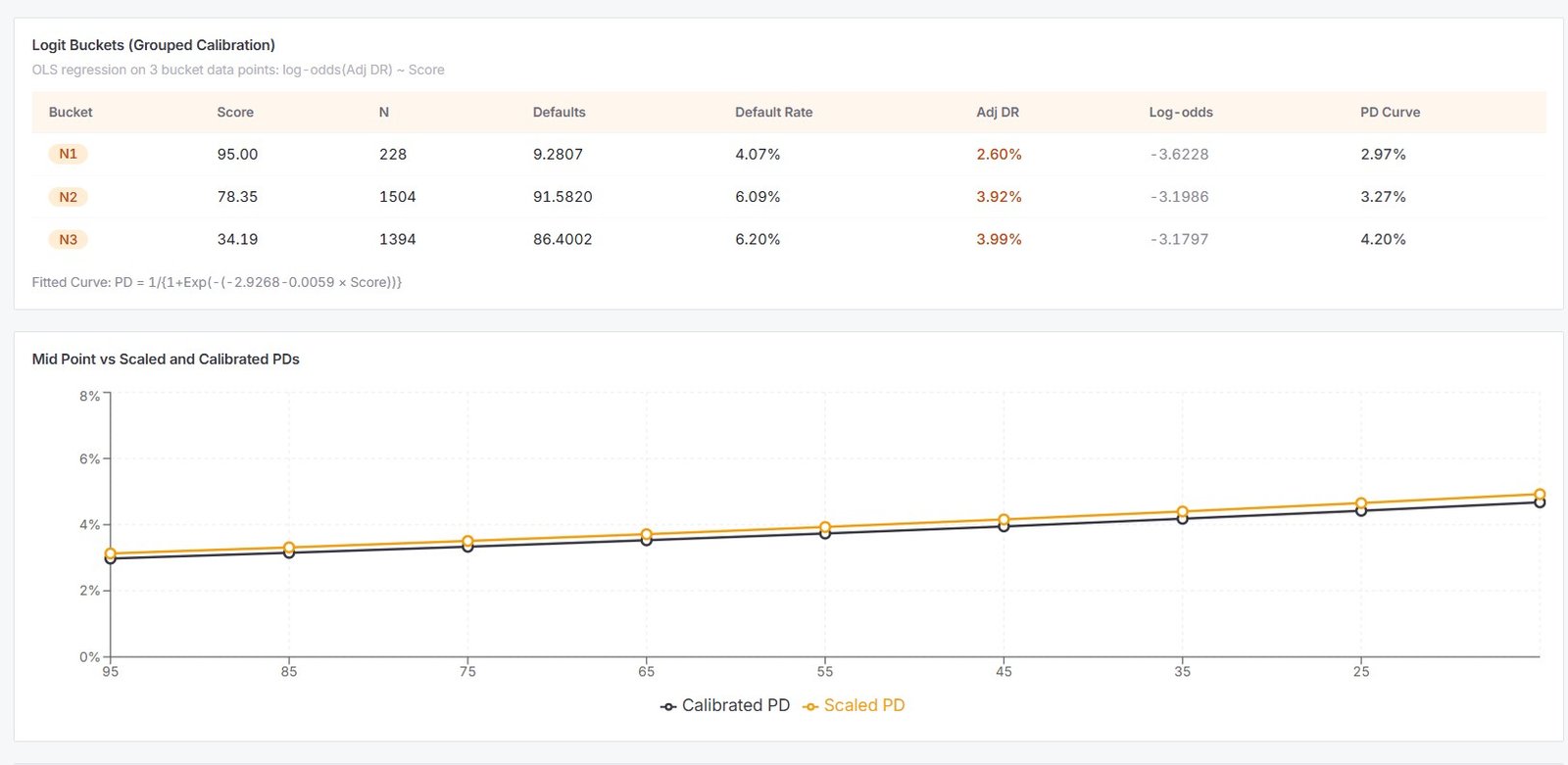
Logit PD Calibration — OLS regression parameters
PD Calibration

Logit Model & OLS Regression

Logistic regression maps TTC-PD to PIT-PD via macroeconomic factor. Full OLS output: coefficients, standard errors, t-statistics, p-values, and goodness-of-fit metrics for audit sign-off.

PD Migration Matrix — 7-year historical
Migration Analysis

7-Year PD Migration Matrix

Year-over-year transition probabilities across rating grades built from your historical data. Cohort-level detail, vintage segmentation, and trend analysis — forming the foundation of the PD calibration engine.

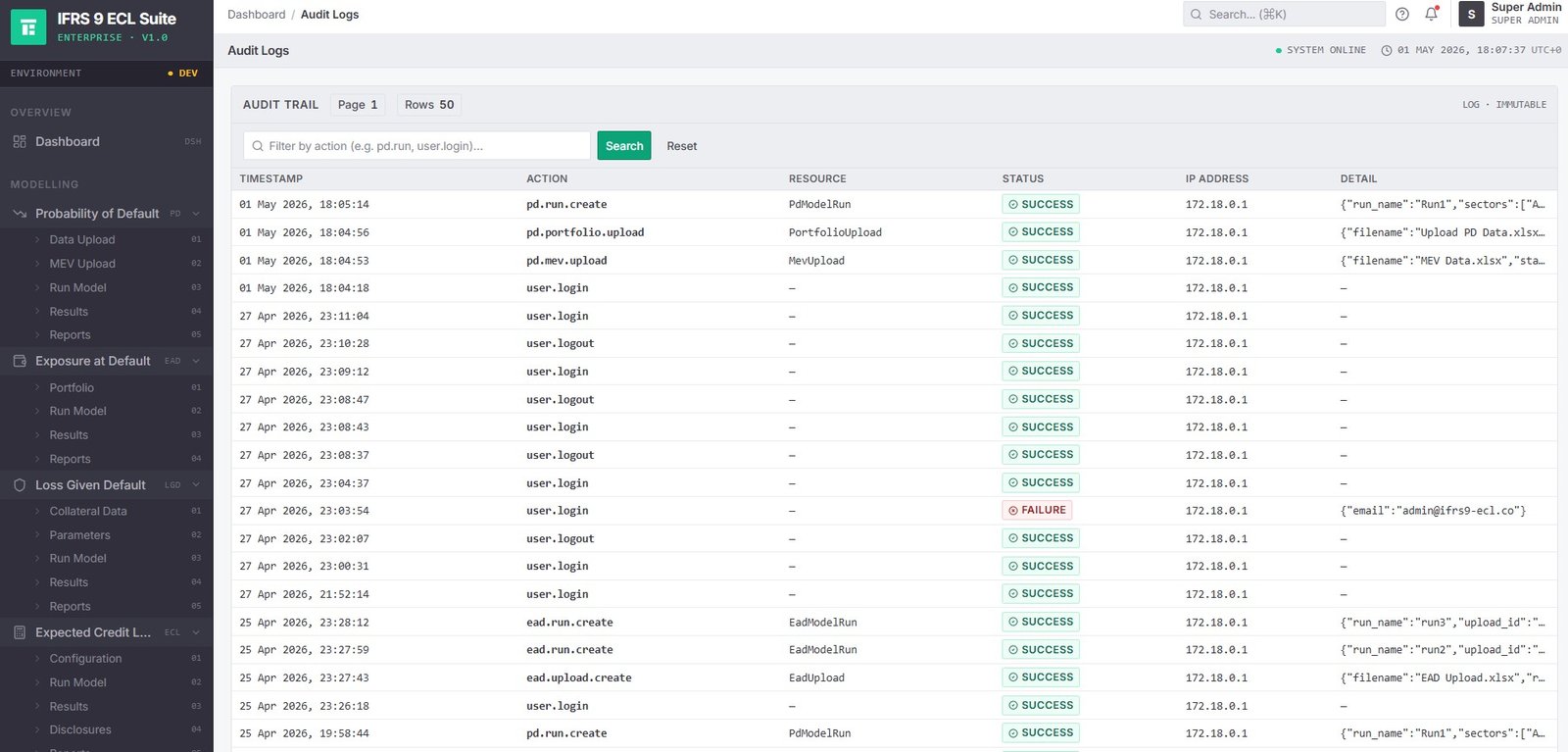
Immutable Audit Trail — timestamps, user IDs, IP addresses
Enterprise Ready

Built for Regulated Financial Institutions

The IFRS 9 ECL Suite is architected for the governance, security, and auditability requirements of banks, finance companies, and asset managers operating under regulatory scrutiny.

Immutable Audit Trail

Every model run, data upload, and parameter change logged with timestamp, user ID, and IP address — tamper-proof.

REST API v1.0

Programmatic access for batch portfolio uploads, model runs, and result retrieval — integrates with core banking systems.

Role-Based Access

Granular permissions for modellers, reviewers, and approvers — with segregation of duties controls enforced at the platform level.

Auto Model Documentation

Full model documentation auto-generated: methodology narrative, assumption log, validation results, and sensitivity analysis.

From Portfolio Data to Provision in Three Steps

1

Upload Portfolio Data

Load your loan or receivables portfolio via template upload or REST API. The platform validates data integrity and flags missing attributes before processing begins.

2

Calibrate & Run Models

Configure PD migration inputs, LGD parameters, MEV variable selections, and scenario probability weights. Execute the full PD → LGD → ECL chain with a single click — every step logged.

3

Export & Disclose

Generate provision journals, IFRS 7 disclosure notes, movement reconciliations, and sensitivity analyses — packaged audit-ready with complete model workings attached.

The Advantage of Built-In Expertise

01

Accessible to Finance Teams

Designed for accountants and credit risk professionals — not quants. The platform guides users through the IFRS 9 methodology with clear inputs and explainable outputs.

02

Statistically Rigorous

Full statistical modelling pipeline — migration matrix, logit calibration, MEV regression. Every number is traceable to its source data, assumptions, and methodology documentation.

03

Cuts Audit Preparation Time

Complete methodology documentation, model validation reports, and sensitivity outputs are generated automatically — reducing ECL audit cycles and eliminating spreadsheet risk.

See the IFRS 9 ECL Suite in action

Request a personalised demo and let our team walk you through the platform using your own portfolio data.